Sunday, 5 October 2014

Forever in days - Story Development


The following are new developments I intend to use when writing the script.

Character Summaries - more details about their character which will allow me to determine situations and events for the plot. I intend for both characters to be the complete opposite of the other as I feel this will work well for comedic purposes and also serve well to the change in both characters at the end. She is looking to break free from her demise while he is looking to put himself back together. Their respective journeys which will intertwine mid way will allow them to achieve their goals. 


Possible Locations

Tenterden town. I've chosen this area because it has this rural charm about it that I feel will work well for my story. My main character Mary Anne is quite the introvert and placing her in a wide and open space is one of the ways in which I intend to express that part of her personality. She and Jeremy come from two entirely different places and will find their answers where they least expected it. This location will be used for most of their dates/activities scenes. There are also a lot of lovely places that are great for sunset shots.


My Opening and closing scenes will take place in a more solar and open setting. I felt the white cliffs in dover/eastbourne would be good for the Voice over that will start the film. I intend for my character to be in the middle of all the emptiness to really captivate in viewers that feeling of abandonment or being left behind for another to peacefully move on.The open sky and sunlight will create the lens flare which will give the feel of another presence that isn't visible.

Below are some locations I have sourced online that I am hoping to use for this project. I took quite a while researching into this as I really want the story to be told visually rather than easily said.I feel the locations chosen will best represent my characters with a few props added here and there to make the characters even more relatable.

(Jeremy Scott's 'secret pad' in his aunt's garden)
I found this place online and instantly took a liking to it. It's fun, cosy and quirky like I intended for my character to be. This serves as a huge contradiction to where he is coming from and is a metaphor for the parts of him he is unwilling to accept until he meets Mary Anne. 

(Mary Anne's House)
I felt this was perfect because it was humble, Isolated and precise in its tones like MaryAnne. Homes reflect personality, flare and character. I want this to pertain to my story too. The house to me seems like a white canvas begging to be splashed with paint. It's bare and can still do with a little more colour. This can be seen as a metaphor for the excitement Mary Anne has been lacking most of her life until Jeremy.


Friday, 3 October 2014

StoryTelling Unit: The Meeting | Forever in Days


PITCH - Live every moment, love every minute. A tale of life and death and two souls caught in-between. 

MaryAnne and Jeremy share a love that sweeps them on an emotional journey through love, life and death. Living and Loving every moment they await their bittersweet end. 


Genre - Drama / Comedy 
Location - A village in the countryside - Home, Bedroom, Coffee Shop, Outside. 


Characters : 

Mary Anne - is a patient suffering from neuroblastoma cancer since the age of five. She lives with both parents in a cottage in the village. Given failure of various treatments over the years she has finally arrived at the end of her life With one month left to live. Her Illness robbed her of her happiness and stopped her from living a life that was ordinary and special in it's own way. Through discovering this tragic news Mary Anne Decides it's better to live in these last few days than to not have lived at all.

Jeremy Scott - A neighbour that has just moved into the residential area with his parents from a well populated and full of life city. He is eccentric, charming and spontaneous - Exactly what Mary Anne needs in her last few days. Through a first encounter he discovers she is very pessimistic and unbothered about life and takes it upon himself to help her find meaning in her life.

The Story Idea: 

Mary Anne is Twenty Two years Old and dying. Having been told she has a month left to live she sums up strength she's never had to live life fully in her last few days. Throughout the experience she learns more about life, death and a love which she never knew she could feel, allowing her to depart from loved ones and life itself peacefully.

Goal - To seek meaning in her life and do as much possible in her remaining days to avoid dying unhappy.

Problem - She falls ill before a major event with Jeremy causing concern and showing signs of her life quickly diminishing.

Change - She gains a strength she lacked most of her life and finally has found meaning in her existence. She has lived, loved and like we all must one day, died.

Wednesday, 1 October 2014

Storytelling Unit - What is a story?


''...A  story is first of all a chain of events that begins at one place and ends at another - without any essential interruption... ''

Other definitions of a story:
  • A detailed description of a situation/event.
  • Fiction/Non-fiction 
  • Sequence
  • Point of View/Perspective
What are the Ingredients of a story?

Theme >> Plot >> Story structure >> Characters >> Setting >> Style and Tone >> Goal, Change & Problem >> Climax

A theme is an important message the story is passing across to it's readers. It is effective it will touch an aspect of the reader's life in an emotional and thoughtful sense and in it's own small but sweet way help out in the lives of many.

The plot of a story can be considered as the detailed ins and outs of the journey that starts with the main character at the beginning and draws to a close at the end. The plot will consist mainly of conflict against other characters or a personal struggle. Throughout this journey, the character will grow and learn many things alongside the audience. This little piece of wisdom the character will earn when it is most vital can also be recognised as the over all theme of the film.

Story structure is all the methods used to piece all the ingredients together. Is the story in present tense or past tense? Does the use of first person narrative sell the story more? or does third person narrative allow your readers dig deeper into the characters as though to play God? Will the story be told in the eyes of one character or all characters? The choices made here will determine the outcome of the story.

Characters are who the stories are all about. Perhaps the main character who could be either an antagonist - the villain of the story, or the protagonist - the hero or main person of the story, has an obstacle to overcome, a goal to achieve or both. The build up of a character depends on your creative capacity as a writer somewhere between safe and spontaneous is always good it adds to the element of surprise in a story. A perfect character rarely ever works well in fiction, most times they have a flaw or weakness they overcome by the end.

Stories should be set in places and times that will be interesting or familiar. This contributes a lot to context - these are other events or issues that frame/influence the meaning of the story given that they happened during the same period of time.

Style and Tone are important when writing. If it's an intense drama some use of emotive language should be in effect to really capture the hearts of avid readers, if it's a thriller an in-depth but ambiguous telling of opinions might be a good way to show deception and lack of truth or confusion amongst characters. Plain or complex language can be used depending on the nature of the story and its characters. 

Goal, Problem and Change these are the various challenges the characters will face throughout the course of the story. Reflection of real life issues in narrative is a good way to draw in an audience as it is easy to relate to and understand. 


Tuesday, 23 September 2014

The Meeting | Coming up with ideas: The art of lying


Story Idea –
Two former schoolmates, “THE DICK” and “SNOOZY LUCY” who hardly knew each other back in the day, have an encounter in which they discover a whole lot more about each other. A friendship is developed through which Lucy discovers there is much more to Tom than his wicked ways in high school and that he is capable of much more than he believes.  Over time Feelings are developed which lead to the prospect of a relationship however Tom has built this friendship partly on lies. After a heated argument they both realise they’re better with that without each other.


Genre – Romantic Comedy
Title –  Jock and the geek?????

Character (The Artist) – Lucy Whittle: (Snoozy Lucy)

Appearance description –

·      Shoulder length and super curly brunette hair
·      Hazel brown eyes
·      Full heart shaped lips
·      Bushy but neat eyebrows and fluttery lashes with a pair of fully prescribed glasses
·      Warm but porcelain skin with rosy cheeks
·      5’4’ in height, slim in figure
·      Baggy and simple sense of style


Personality description – Shy, cute, innocent, introvert

Character (The Plumber)  - Tom Jeffries (THE DICK)

Appearance description –

·      Clean cut brunette hair (shaggy and spiked)
·      Warm brown eyes
·      Straight cut jawline, good dentition.
·      Straight brows
·      Bronzed skin
·      Tall 6’2’ with nice abs
·      Big strong hands and biceps
·      Conventional plumber look – white tee, tattered trainers, ripped old looking jeans.
·      Mini white van.

Personality – spontaneous, funny, charming, witty, charismatic, Vulnerable (Within himself/ no one else knows his insecurities.)


Cross Cut between shots of both characters

Both getting ready to head out, Shower, Hair, make up etc.? Grabbing a pair of shoes, looking at phone messages and the time to be sure they’re punctual. Walking across the hallway to approach the front door. Very different surroundings in both houses however artistic in their own respect.


StoryTelling Unit - SOFT 25 word pitch

PLOT: Written and Directed by Simon Ellis, Soft is the tale of a fragmented relationship between father and son when confronted by a group of rebellious teens in the comfort of their own home.
We had previously watched the film in a lecture and explored the themes expressed in the film and how well they were captured visually. Having done so, we were asked to go back and re-watch the film and create a 25 word pitch that would best describe/sell the film.


* A father and son relationship is tested when confronted by a group of angry teenagers.

* A modern society drama sees through the deterioration of a father and son's relationship when both    are made victims of teenage violence.

* A son stands in confidence when his father is tested by a group of ill mannered teens.

Monday, 7 July 2014

Commission Documentary Post Production reflection

To view the individual work I did in post production please look at the videos below:


The latter part of the project revealed a lot to me in terms of our individual approach and working in groups. I feel we all started off fairly well. We had an Idea and were ready to implement it. From the start I played quite a strong role in our group until I noticed it caused a bit of a strain with our friendship. Everyone wants an input but it hards to put down an idea especially when it comes from your friends. I knew exactly how I wanted this to turn out and it came out far from what I had hoped which is rather unfortunate given that we all worked extremely hard on this unit. Towards the middle Colleen expressed to us that she felt left out and there was more communication between the two of them than all of us a group. It was made to seem like I was controlling everything when in actuality I was the only one looked to for the answers which I couldn't quite understand. So to lessen the tension between us, I backed down in terms of the creative aspect and let them move forward with ideas that they had. In general, this entire process has taught me not to be afraid to say what is on my mind where our work as a group is concerned because the grade will affect all of us in the end. The editing process was rather rough given that we had to edit separately to buy us time before our deadline. We were so wrapped up in work that we hardly had time to do anything extra. I had done some casting for reenactments but that went to waste due to lack of time. A lot of our issues on this project stemmed from not following our schedules for the days had we done so we would have done much better. In addition I also feel we could've done much better as a group. I am very individual minded but i can learn to work and exist with others on a group project and had little feuds and emotions been put aside we definitely would've reached our goal.

For a more detailed outline on the latter part of the editing process and closer towards our submission dates please go to my commission documentary page.

Commission Documentary - Production work and reflections

day 1 - Filming 'Mummy and me' group

Having decided with Andrea that it would be lovely to film their support group sessions we decided to film mummy and me to capture the footage required for the documentary. Over the period of filming we got a lot of lovely shots of children laughin, playing and interacting with each other, the officials, and their parents. They sang songs together and were all very jolly. Sei-Kai was the camera man on this project and I felt she got some strong and lovely close up shots that capture love warmth and happiness in them. In addition she got some varied long and mid shots as well to capture action and more characters. 

One of our major problems on that day was the fact that we couldn't get permission for all the children so we ended up having to get rid of some nice shots that had thise specific children in it. It also made it hard to film in such a confined space given that there were children all over the place. In addition, we had to keep a close eye on our equipment to avoid danger or conflict of saftey where the children were concerned. In addition, we also had plans to interview parents and get a personal opinion on the charity but we were cut short of time as we focused too much on getting shots of the children which cost us some valuable information that could have helped piece our documentary in the long run. We were also cut short for time given that we had to fill out consent forms and risk assesments. 


day 2 - Interviewing Zoey

Given that I wasn't available on this particular date, it caused a lot of issues for our group as I feel I played a strong part in project management and ensuring everything was done right. The girls were left to film the interview with Ronnie and Zoey and had a hard time figuring out lighting and sound given that Ronnie could be quite noisey and seeing as its still a part of actuality there wasn't much they could do to change that so they went on with it. In addition, Zoey was very unwell which resulted into bad footage in terms of the sound. Her voice wasn't very audible. A lot of the interview questions asked I came up with during a session we had together after hours at the studios. I decided to work on the questions because I felt I could best articulate what we were trying to say. 

The interview base of the documentary suffered a lot as a result of no creativity in the shots and lack of diversity in lighting etc. Had I been present we most likely would have done a better job. In addition, we couldn't even use noddies due to the presenter bailing out on us last minute. However, over the remainder of the project I compensated my absence through editing and doing my job as the producer. 

Day 3 - Second Interview with Zoey 
After a series of repeated obstacles such as Zoey being ill and personal things to deal with individually in our group, we were finally able to come together and shoot for a second time at the slavation army in chatham. We went over the previous interview and re-did a lot of the questions and added sones we missed to ensure clarity, better flow and a good pace. Afterwards we went down to the park to film some shots of Ronnie and Zoey together, which came out  very nicely. It was also an opportunity for our cast to take a break from hectic questions and schedules and just enjoy the day at the park. We also got more cut away shots at the salvation army centre we got shots of the food bank and workers in the building. 

Shoot day 4 - Cut-Aways
On this particular day we were hoping to get some actuality shots to help cover some of the interview. However, we had no permission to film other students at the school this making it difficult to do our part and get clear shots of Zoey dropping Ronnie in on his first day at a new school. 
Script writing for documentaries -->>

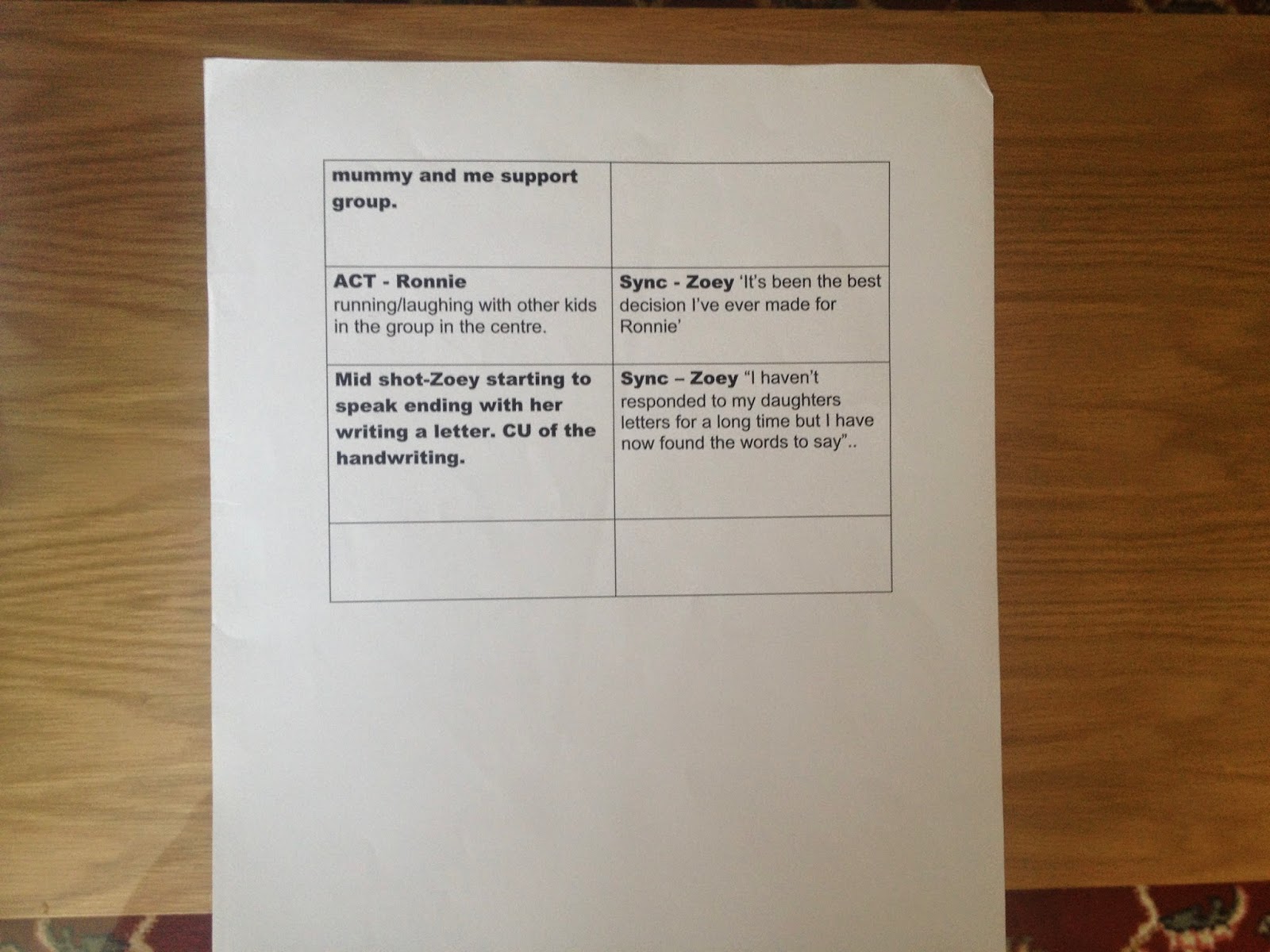
A pre-shoot or shooting script is like carrying a map along with you on a long journey. It allows you avoid strenuous routes, dead ends and minor hiccups along the way. A script is fundamental to the birth of a visual piece as its a guide to what to shoot, in what order and what will accompany each shot. It is often easy to confuse a shooting script with a shot list but it's a mistake filmmakers should try as hard as possible not to make. A shot list coincides with shot numbers, description of the shots and transitions between shots. A pre-shooting script focuses less on the aspects of production and more so on the nature in which the story is visually told/shared and it is also more detailed and descriptive in nature. Below is our first attempt at a pre shooting script. We had a lot of difficulty as we didn't fully grasp the concept of it. But with a few tutorials from Helen we learnt fast and were able to put something together in time to film and use it as a guide.


Given that you can't produce a script before the footage is captured the lack of detail is understandable. However there are steps you can take to accurately portray your footage in a script which are as follows: 
How To Write a Script for a Documentary:
After Shooting is Complete

Log your tapes – This may seem like a tedious and boring task at first, but TRUST ME, you will thank yourself in the end. This is where you begin to "log" and categorize the various "pieces" of your puzzle.

Review the BIG picture. What are the main elements (characters and plots) that have surfaced through shooting process that create the tapestry of your overall story. What are the key “moments”?

Create Scenes. Take these “moments” and divide your documentary into mini-stories (scenes) that, together, create the documentary.

Build a Roller Coaster. Take these scenes and begin creating a “Roller Coaster” ride for your audience. What kind of “ride” are you taking them on? Think about the powerful moments in your story and how to write a script to build up those moments. A fantastic book that describes this process is Writing Great Screenplays for Film and TV by Dona Cooper

Villain and Hero. Another important part of scriptwriting is determining the villain(s) and hero(s) in your story. A hero/villain can be a person, thing or event. (A tornado can be the villain).

BEGINNING, MIDDLE and an END. Of course, every story has a beginning, middle and end. If you can outline your story in these three general categories, then you can begin to fill in the details.

The Ending. If you have a lot of footage and information to work with, a simple way to clarify how to start building your script is to think about how you’re going to END your documentary. Everything else leads up to that.

Start Strong. I cannot express enough the importance of how you START your documentary. This is when you “hook” the audience and set the tone for the entire program. The beginning of your film should:


  • Establish the “core message” of the documentary (this often includes a specific “incident” that is controversial or offsets the balance of forces in some way).

  • Create curiosity -- set up the “problem” or “issue” in the most compelling way possible to tantalize or grab your audience’s interest. Create a situation that makes the audience ask, “Why is this happening?”
 What's in the Middle? It’s easy for scriptwriters to get “lost” in the middle (body) section of the script. Just keep asking yourself, “does this scene/story or information move the story forward and lead to the ending conclusion?” Don’t get attached to any particular footage or information. If it doesn’t fit, leave it OUT. You can always put it in the “Bonus” or “Deleted Scenes” section of your DVD. :-)

Script Template. Finally, once you have a general outline of your story, begin building your script using a 2-column script template: one column for audio, one column for video.


The very nature of the documentary is that it is “unscripted”. It is meant to capture some aspect of “real life”. Then it is up to the you (the writer) to take the messiness of real life and create some kind of story.
As the scriptwriter, you will need to examine all the “unscripted” & “raw” footage and create some sort of structure out of it.
It will seem daunting at first (you WILL feel overwhelmed at some point), but think of it as putting together a great big puzzle. It will look like a jumbled mess at first, but bit by bit, the big picture will begin to reveal itself as you mix and match the various pieces. 

Over the course of production, I was also casting for re enactments these are some of the profiles I Looked through and auditioned on the phone. I was particularly keen on Julia and Caitlin as they best fit the description i had in mind. 


© SLTV Production 2013. Powered by Blogger.

Welcome Box


SLTV Production Copyright © 2011 -- Template created by O Pregador -- Powered by Blogger